
Business Problems
Disorder Was Given Structure
Business Problems examines the recurring pressures, unfinished work, unclear responsibilities, and structural conditions that shape entrepreneurial performance.
These resources help identify what is actually happening, where the correction belongs, and what should happen next.
Begin with the problem that most closely resembles your own.
The Uncertain Territory
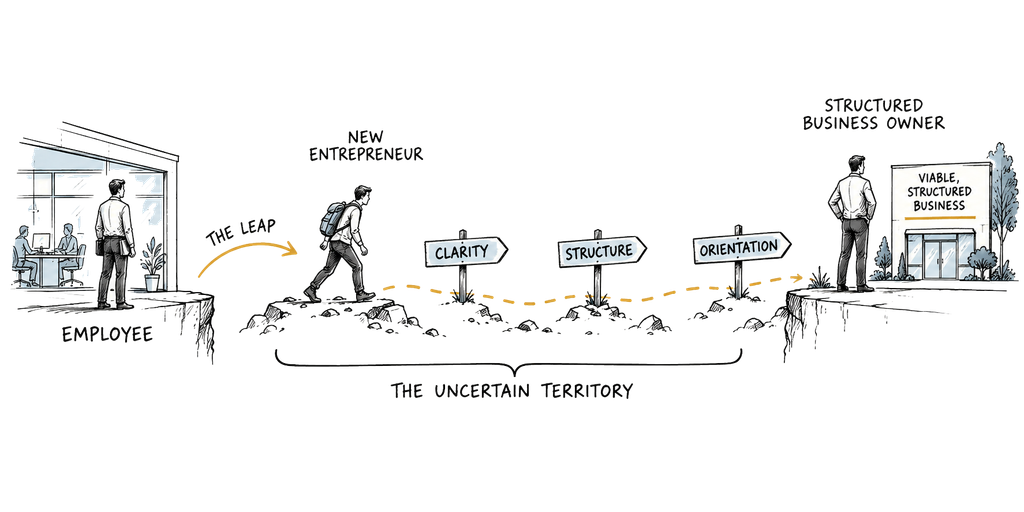
The transition from employee to business owner crosses uncertain territory.
Employment supplied an established structure. Roles, schedules, standards, priorities, and support functions already existed. When a person leaves that environment, the freedom is real—but much of the structure disappears.
The new entrepreneur must answer two different questions.
Is the Business Model Viable?
Before risking income, time, capital, or family stability, the entrepreneur must determine whether the proposed business can produce the intended result.
Is there credible customer demand? Can the offer generate sufficient revenue? Do the price, costs, capacity, and delivery requirements work? What would have to change for the business to meet its stated goal?
This is the work of Clarity. It reduces the risk of pursuing a pie-in-the-sky dream by testing the idea against reality.
Clarity does not decide whether the dream is worthy. It reveals what the dream will actually require.
Can the Business Perform the Necessary Work?
A sound business model is not enough. The work required by that model must be given dependable form.
What functions must occur? Who or what will be responsible for each one? What standards, limits, schedules, and measures are needed? What must remain with the owner, and what can be automated, purchased, delegated, sequenced, or removed?
This is the work of Structure.
A well-organized business built around an unsound model will still fail. A sound model without workable structure can exhaust its owner and remain unstable.
Is the Business Still on Course?
Conditions change. Customers respond. Capacity becomes visible. Results return with evidence.
The entrepreneur must repeatedly compare the intended destination with the business’s present position and decide what matters next.
This is the work of Orientation.
Orientation keeps the business aligned with reality. It may reveal that the structure must change, the model must be reconsidered, or the objective itself requires correction.
From Entrepreneur to Structured Business Owner
Profitability alone does not necessarily mean that a business is sound.
A company may produce income while still depending entirely upon its owner’s memory, heroic effort, constant availability, and improvised decisions. That person may own a profitable job without yet owning a structured business.
The destination is a viable, structured business—one whose model has been tested, whose necessary work has been given dependable form, and whose owner can determine whether it remains on course.
Clarity, Structure, and Orientation do not guarantee that every business will succeed. They give every entrepreneur a better way to determine what success requires.
Before you take the leap, test whether the business can support the outcome you need. After you take it, build the structure required to make the model work.
Choose Where to Begin

Examine your current or proposed business and identify where the correction belongs.

Apply Clarity, Structure, and Orientation to recurring business problems.

Find practical, local guidance for St. George entrepreneurs and business owners.